“A date,” he said, “is like a chavrusa. Only instead of learning, you talk nonsense.”
Matt Walsh recently released a film aimed at answering what should be a simple question: What is a woman?
He traveled the country asking educators, scientists, therapists, and scholars to define womanhood. Astonishingly, in 2025, a significant portion of the population struggles to answer.
I’ll leave that question to podcasts and academic debates. In my pursuit of a doctorate in social work, I’ve spent more than enough time defending the basic facts of human biology to postgraduate students. Instead, I want to explore a different angle—one far closer to home.
Within our communities, to varying degrees depending on how sheltered we raise our boys, many young men step under the chuppah profoundly unprepared for what marriage actually demands. Earlier in my life, I served as a chosson teacher, teaching hilchos niddah. Most boys received a brief, two-hour introduction to the mechanics of intimacy—and that was largely the extent of their preparation. Many had little understanding of what they were truly entering.
A friend of mine once received dating advice from a famous Rosh Yeshiva, a scion of a previous generation.
“A date,” he said, “is like a chavrusa. Only instead of learning, you talk nonsense.”
I’ll say no more.
Now, more than two decades later, I see the long-term consequences—particularly in more charedi circles. Marriages struggle not because of ill intent or lack of commitment, but because they were built without meaningful education about how fundamentally different men and women are—not only anatomically, but emotionally, psychologically, and relationally.
These men know women in limited roles. They remember their mothers. They are familiar with sisters. But there is one role they often don’t understand at all:
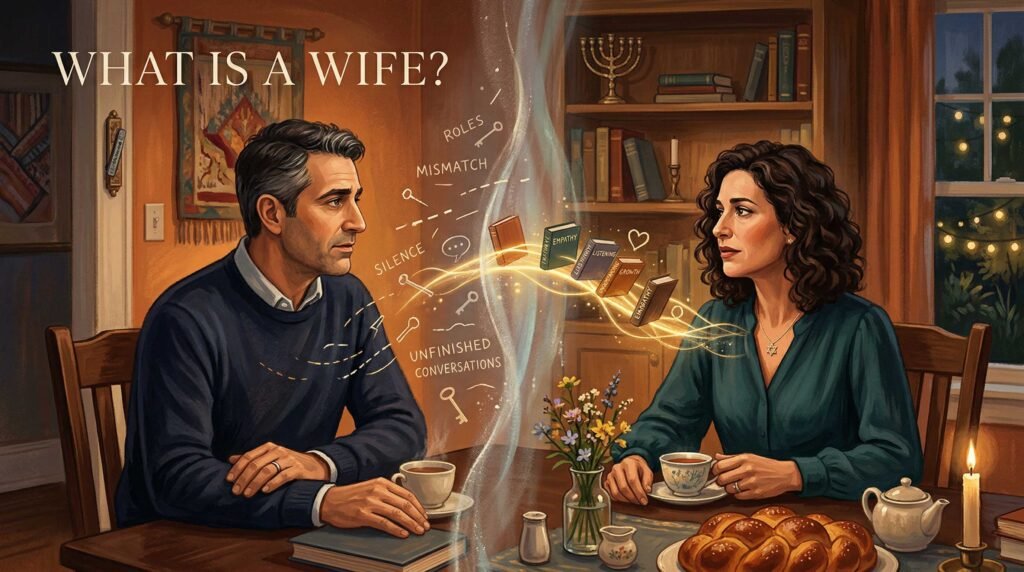
What is a wife?
The Gap Between Knowing and Understanding
What I frequently observe are marriages that lack the emotional intimacy unique to a marital bond. Instead, the relationship unconsciously mirrors a mother-son or brother-sister dynamic. There is affection. There is loyalty. There is partnership.
But there is no romance.
Two people may deeply care for one another, may even love one another—but they are not in love. The marriage becomes a partnership of convenience rather than a living, breathing relationship between two distinct adults—each seen, desired, and emotionally known.
That gap—between knowing women and knowing one’s wife—is where so much quiet suffering begins.
The Role of Psychoeducation
As therapists, we are trained not to give advice. We don’t tell people what to do. But we do educate. Clinically, this is called psychoeducation. And more often than not, this is where much of my work lies: helping men learn how to relate to a woman properly—how to understand the language of emotion and empathy; how to distinguish anger from a deeper desire to be seen and desired; how to navigate conversations governed as much by what is not said as by what is.
The most effective strategy, of course, is prevention—being proactive. Giving young men a preview not only of anatomical differences, but of differences in self-perception, emotional processing, and cognitive frameworks.
There is no one-size-fits-all formula. Every individual brings their own personality, history, and traits into a relationship. But a shared baseline—an orientation—matters.
I have seen marriages shift, soften, and even revive once that basic framework was finally made clear.
The Path Forward
For some, this understanding comes naturally. For others, it requires guidance, language, and space to ask the questions they were never given permission to ask. When men are offered education rather than criticism, and insight rather than shame, relationships have the opportunity to grow into something deeper, more connected, and more alive.