The First Laws — And the Soul of Shabbat
Parshat Mishpatim opens in a way that often surprises us:
“These are the ordinances that you shall set before them.” (Exodus 21:1)
“When you acquire a Hebrew servant, he shall serve six years—and in the seventh he shall go free, without payment.” (Exodus 21:2)
The Torah begins its civil code not with Shabbat, not with charity, not with ritual — but with laws regulating servitude.
At first glance, this feels jarring. Why would the Torah of a nation destined to be a light unto the nations begin here?
The Torah does not present an idealized world detached from human reality. It speaks into the world as it is — and elevates it. In a civilization where slavery was universal and unchecked, the Torah introduced dignity, limits, time boundaries, and protection. It transformed ownership into responsibility, power into guardianship, and authority into moral obligation.
But beyond the legal framework lies a deeper layer.
The Zohar teaches that these verses hint to something far more expansive: the journey of the soul.
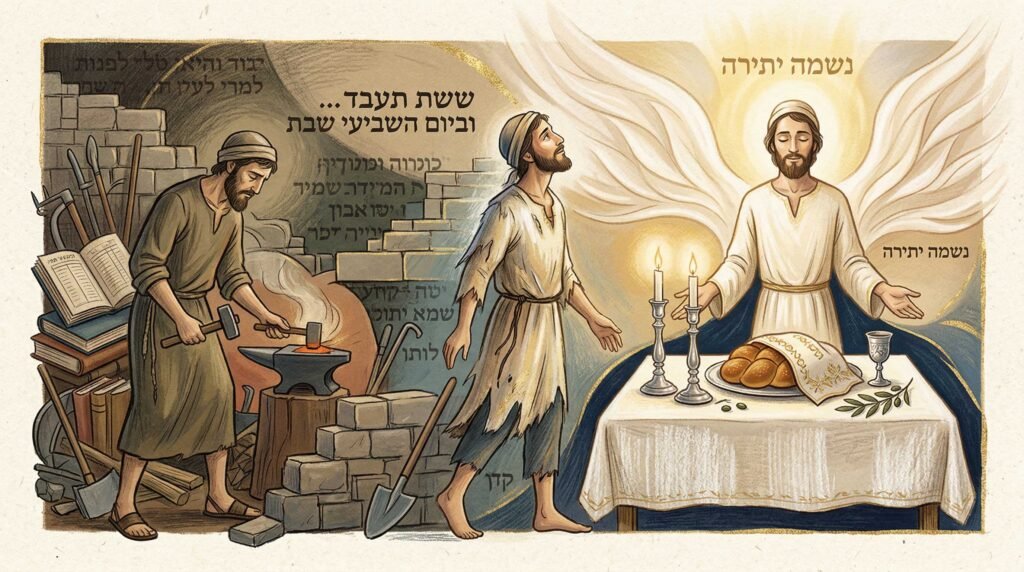
There are souls that resemble the “six-year servant” — souls that enter the world through layers of concealment, struggle, and spiritual labor. And there are souls that resemble the “seventh year” — souls that express a more revealed, elevated spiritual state.
The Zohar parallels this to the rhythm of time itself: six days of weekday (“chol”), and the seventh day — Shabbat.
During the week, we function within structure, effort, hierarchy, and mediation. Our lives move through systems and responsibilities. But on Shabbat, something shifts.
a blessing,Before the Friday night meal, we sing Shalom Aleichem, greeting the angels. We welcome them, ask for blessings, and then gently bid them farewell.
Why?
On a simple level, we acknowledge the angels who accompany us home from shul. But on a deeper level, Shabbat changes the spiritual order entirely.
The Zohar teaches that on Shabbat, every Jewish soul rises beyond the domain of angels. No intermediaries. No layers. We connect directly to Hashem. On Shabbat, every soul experiences its wholeness.
The weekday soul and the lofty soul become equal. The one who struggled all week and the one who soared all week both stand in the same light.
Perhaps this is why “Shabbat Shalom” can also be read as “Shabbat Shalem” — the complete Shabbat. The day when the fragmented becomes whole. The day when the servant goes free. The day when every soul tastes its purest self.
May we all merit a Shabbat that reminds us who we truly are — whole, connected, and deeply cherished.
Shabbat Shalom.