Chesed—kindness, giving, helping.
We’re taught it’s the heart of being a “good person,” someone worthy of God’s grace.
And it does feel good to give.
To save. To provide.
To be needed.
Arguably, if done right…
It’s the best feeling in the world.
But sometimes, giving leaves us empty.
Drained.
Resentful.
Even devastated.
In a world where therapy is everywhere and clinical terms fly fast—many of us start to wonder:
Am I codependent?
So here’s a little history and self-reflection.
And an invitation to one of the most sacred spaces I know:
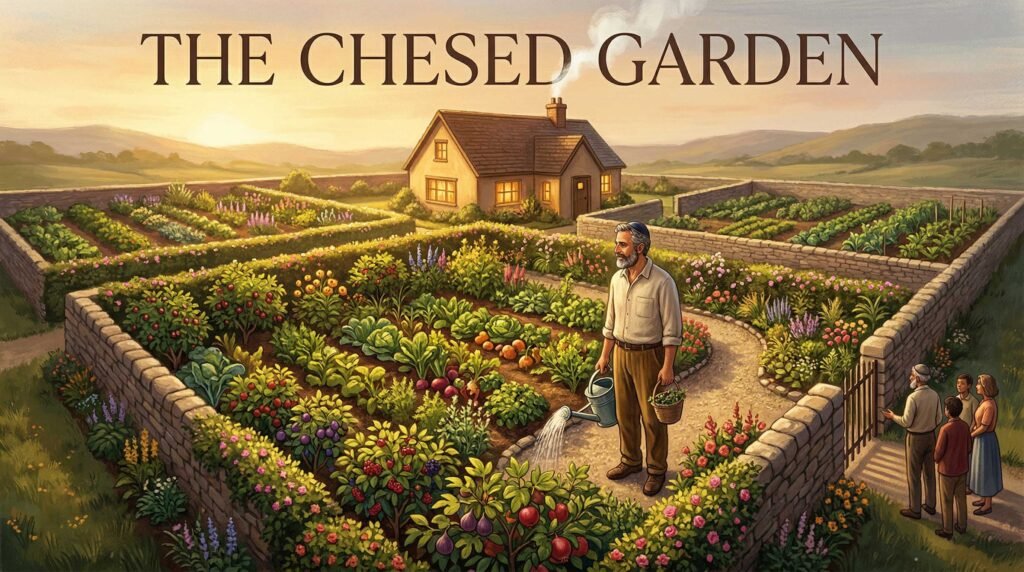
The Chesed Garden.
I was born 44 years ago in what was then the Soviet Union—an empire built on fear—and what is now the young, war-torn country of Ukraine.
Whatever waves of antisemitism are sweeping through Western civilization today don’t come close to what it meant to grow up in a place where being a Jew was officially considered a liability.
In that world, Jewish unity wasn’t about community events or cultural pride. It was about survival.
They didn’t like us. Not privately. Not subtly. Officially. It was government policy. And so, Jews did what they’ve always done through centuries of exile and persecution—they clung to one another.
But I didn’t get to be part of that.
My parents did well. Too well. Well enough to be granted an apartment in the part of town where Jews weren’t exactly welcome.
So when I went to school, I was the only Jewish kid in a class of thirty.
And let me tell you—
It sucked.
Aside from the fact that my face made my Semitic roots unmistakable, the class roll book sealed the deal for anyone curious enough to check.
Uzhansky.
Jew.
And yes—they checked. Just to be sure.
Social life? Not great.
But I learned a few things.
Kickboxing.
How to run really fast—super fast.
And this: social life improves when you make yourself useful. Needed.
Irreplaceable.
It’s not that complicated.
Give people something they want, and—for a little while—the length of my nose doesn’t matter.
I’d go to the local kiosk that sold foreign contraband, buy a stash of Bazooka gum, hand it out to my classmates… and voilà—suddenly, I was popular.
At least until the gum ran out.
I learned early: social status, human connection, friendships—they’re transactional.
It became my way.
My weapon.
My salvation.
And eventually…
My nature.
Usefulness = Connection.
Even later—after the USSR collapsed and my parents sent me to a Jewish school—my surroundings changed.
But I didn’t.
My methods did.
As I got older, they evolved.
A smile could earn an acquaintance.
A well-placed joke? A friend.
A favor? A follower.
Slowly, I stopped seeing myself for who I was… and started seeing myself only in terms of how I mattered to others.
And once again—
It sucked.
Because now, they held all the power.
Fast forward many years—
I was married. Raising young children. A community leader.
Google my name—you’ll find it all. The good. The bad.
In the beginning, it was exhilarating.
In the world of outreach, it’s easy to feel like a hero.
Saving Jewish souls. Guiding Jewish kids.
And beyond that—
People have problems. In case you didn’t know.
And when you become the one they turn to—the one they cry to, lean on, praise—
It hits hard. The pleading eyes. The thank-yous. The constant validation.
(Yeah… I’ve grown to hate that word.)
If your sense of self comes from being needed? From being relevant?
It didn’t suck.
It just cost me everything.
My family.
My career.
Sometimes, my sanity.
But it didn’t suck.
Until it did.
I won’t go into details. Not here.
Anyone with a search engine can piece it together.
Nothing terrible, if you’re wondering.
Not what some might have assumed.
But enough.
Enough that I had to start over—
Not rebuild,
Build.
Find myself—
Not again…
But for the first time.
Because when all you know is validation,
When your worth depends on approval,
The void inside doesn’t shrink—
It grows.
Maybe because… there’s no you in there.
Maybe because, piece by piece,
You give yourself away.
Each piece of gum.
Each smile.
Each “heroic act” that makes headlines—
Takes something from you.
Until there’s nothing left.
And yeah—
It sucks again.
Maybe I’ll save that part of the story for another post—
The part where I stepped back. Looked inward.
Asked better questions.
Found better answers.
Grew.
Enough to say, without shame, that I’ve become… selfish.
In the best way.
I do what’s good for me.
I think what’s good for me.
I say what I think—
Not what they want to hear.
And anyone who really knows me will tell you…
That part?
I’ve nailed.
So how am I not a jerk?
Ta-da.
The Chesed Garden.
You see, every house needs its essentials—
A solid foundation.
A kitchen. A bedroom.
A living room. A porch.
And yes… a bathroom.
(That’s a whole other post.)
But just as important?
A garden. A Chesed Garden.
One that exists within your boundaries.
One you nurture on your terms.
Filled with what you want to grow.
What you are capable of growing.
Without it, the house isn’t whole.
It’s just walls.
So… how does it work?
Let me tell you about my garden.
Openly. Transparently.
And then I’ll show you how to plant and tend your own.
Mine has different sections—
Laid out according to my understanding of Torah…
And yes, with a few personal touches.
The first section?
Belongs to me.
It feeds me.
Because if I’m starving, I can’t feed anyone else.
Don’t argue.
Just listen to that stewardess on the plane: oxygen mask on yourself first.
The richest crop in that section is time.
Alongside it, I grow compassion, understanding, and yes—validation.
(Just a little.)
And acceptance. Of myself. As I am.
From there, the garden spills over into the next section—
For my family.
My wife.
My kids.
Then, and only then, it extends to my community.
But again—not based on what they need,
But on what I’m able to give.
And only after that—
Do I take inventory of what’s left.
And offer it—intentionally—
To those who ask.
Think of it like a specialty pharmacy.
We only stock certain meds.
The ones Hashem gave me to distribute.
No more. No less.
Remember that old Navardok trick?
They’d walk into a furniture store and ask for milk—just to feel embarrassed.
Oh, I relate.
Only in the past, if I was the furniture store,
I’d build a barn in the back.
Get a cow.
And hand over a full gallon to that poor guy asking for milk.
Now?
It’s simpler.
Now I just say—
“No.”
Or:
“Sorry, the supermarket is that way.”
Now… I have all the power.
No, not in the way you might think.
Of course, it all belongs to Hashem.
But I think… we’ve come to an understanding.
At the end of the day, He’ll hold me accountable—
So I get a say in how it’s spent.
Anyway—
This is how my garden works.
And somehow, within that structure—
That rigidity—
More people are helped.
More deeply.
More meaningfully.
In ways that actually last.
Because my chesed garden…
Feeds me.
Every part of it.
Even the sections planted for others.
There are parts of us that are meant to be used for others.
Of course.
The Torah makes that clear—10%.
If you’re truly “privileged,” 25%.
And it’s not just about money.
It’s time. Emotion. Thought. Energy.
And it’s not just how much—
It’s what.
A farmer doesn’t make shoes.
A doctor doesn’t patch jeans.
Hashem gives each of us unique gifts—
Talents, resources, experiences—
Not all for us to keep.
So… how do you build your chesed garden?
Start with a personal inventory.
Figure out what kind of vegetables you’re meant to grow.
For you.
For others.
Because here’s the problem—
In today’s world of likes, followers, and instant feedback,
We fill our gardens to feed everyone else.
Not ourselves.
Our identities have become transactional—
Built around what makes us relevant,
Instead of what makes us whole.
No wonder everyone’s starving.
Let’s fight that hunger.
Together.
Figure out what truly feeds you.
And maybe then…
You’ll discover what you’re actually meant to grow for others.